MARKET ANALYSIS
ETF emerging markets: Early bird catches movement before it becomes significant

PART
Over the past few months I've noticed how ETF emerging markets are once again moving more strongly than we've been used to for a long time. Not because there's suddenly some remarkably positive news circulating, but because the price trend itself is showing a different direction.
Sufficient reason for a contribution about the renewed movement in emerging markets ETFs — and how you as an investor can recognize those signals early.
ETF emerging markets versus Europe: a relationship that is rebounding
When regions lag behind for decades, attention naturally fades. Yet, new trends often emerge during such quiet periods.
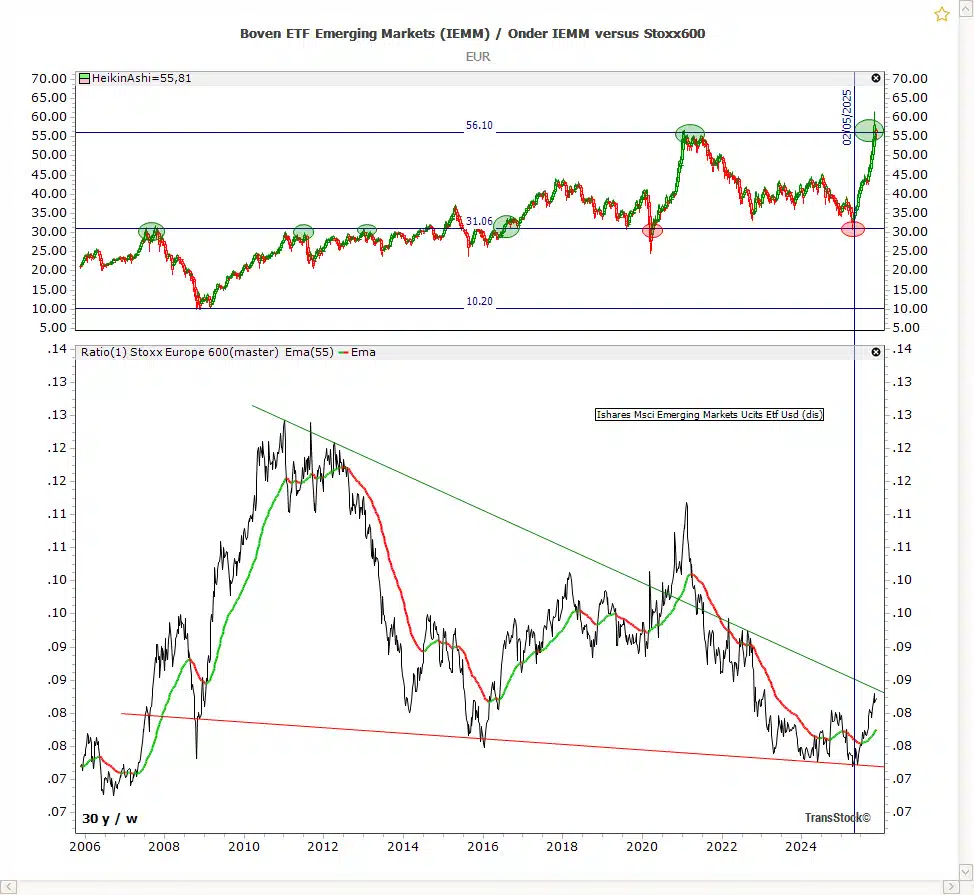
Are you looking at the ratio between ETF emerging markets via the ETF IEMM against Europe (Stoxx600), you will notice in the lower part of the chart that this ratio is again approaching a zone that has served as a pivot point several times in the past.
Do you see the rise since the vertical blue line (May 2025)? From a support zone towards a resistance zone? That is exactly the type of movement that has often historically marked the beginning of longer phases in which emerging markets ETFs outperformed Europe.
The ETF itself (top of the chart) is also approaching its all-time high—four years ago now. That's precisely why I follow these kinds of relative ratios when I'm looking for the first signs of a trend change.
The investment software TransStock continuously tracks these kinds of movements and shows, often faster than news reports, where capital is flowing to.
Latin America ETF: Quiet on the surface, meaningful on the chart
The Latin America ETF (LTAM) also shows a pattern that is worth watching for those invests in emerging markets ETFs.

If you look again at the ratio against Europe (bottom part of the chart), you'll see that the support zone held in April. There's no sudden reversal visible, but there is a stabilization that often precedes a new trend.
Note the upward reaction on the right side of the chart. It seems like a small detail, but such details often mark the beginning of longer movements.
Why? The Latin America ETF is trading near its 15-year descending resistance line (top of the chart). A break through this line quickly opens up a range towards price targets around 17 and 18,5.
A breakout confirms a trend reversal. The best way to track this is with an alert just above 16.
What do these movements mean for you as an investor?
These observations are not predictions. And that's precisely what makes them so useful.
When a ratio moves, it shows where the capital is flowing. Who invests in ETF emerging markets, can thus tap into a force that is already present — even before it is widely discussed.
How can you deal with this?
1) Just looking occasionally is enough
Not daily, not obsessively. A monthly check is enough to see if emerging markets ETFs move more or less strongly than Europe.
2) Pay attention to simple signals
Higher lows, stabilization zones, or a breakout above a descending line are often the first signs of a new rhythm.
3) Small accents make the difference
Those who respect the movement don't need to take large positions. A slight shift toward regional momentum is often sufficient.
4) Combine with your fundamental look
Show technical observations wanneer something moves. Your fundamental analysis determines what You choose within that region. Together they reinforce each other.
If you want to deepen your foundation, you can find additional context via investing for beginners.
A brief look at the ETFs discussed
- ETF emerging markets show a series of higher bottoms.
- Latin America ETFs are attempting to complete a long bottoming process.
- Europe remains relatively stable, making any shift in the ratio more significant.
What have we learned from this technical analysis contribution?
- ETF emerging markets are showing signs of relative strength for the first time in years — quietly, but structurally.
- You can recognize outperformance most clearly through ratio charts.
- By regularly monitoring these ratios, you can see where capital moves before it becomes a story.
- A longer horizon helps you distinguish structural trends from temporary hypes.
From observation to a repeatable approach
Anyone who wants to monitor ratio charts and relative strength on a regular basis will benefit from a fixed routine with clear filters and alarms.
Within the TransStock environment movements are made in ETF emerging markets systematically monitored, so that you become less dependent on headlines and more on what the market itself shows.
He who looks early sees movement before it becomes meaningful…
Aroon indicator - Short FAQ
What are ETF emerging markets?
Emerging markets ETFs are exchange-traded funds that invest in stocks or bonds from emerging markets such as China, India, Brazil, and other rapidly growing economies. They offer diversification across multiple countries and sectors within a single instrument.
Why invest in emerging markets ETFs?
Investing in emerging markets ETFs can be interesting because these regions often grow faster than developed markets. They can also provide additional diversification within an investment portfolio in the long term.
When are ETF emerging markets interesting?
ETFs in emerging markets become particularly interesting when they begin to outperform other regions, such as Europe or the US. This is often visible through ratio charts and the formation of higher lows.
Are emerging markets ETFs risky?
Yes, emerging markets ETFs typically experience more volatility than developed markets. Political uncertainty, exchange rate fluctuations, and economic shocks can have a greater impact. Therefore, timing and diversification are important.
How many emerging markets ETFs should I include in my portfolio?
Technical analysis helps determine when emerging market ETFs begin to gain momentum. Fundamental analysis determines which regions or funds you prefer. Together, they provide a more structured approach.
Should I actively monitor emerging markets ETFs?
No. For many investors, simply looking at relative performance compared to other regions on a monthly basis is sufficient. Major trend shifts usually occur gradually.
Are emerging markets ETFs suitable for beginners?
For beginners, emerging markets ETFs aren't usually a starting point, but they are a potential extension once the basics of diversified investing are understood. Education and a long-term perspective are essential.
Disclaimer: The information on this blog is for educational and informational purposes only. It does not constitute investment advice. Investing involves risks. Always do your own research before making any financial decisions.